

2026 Black History Month Celebration Spotlight
- The Lawrencian
- Mar 26
- 5 min read

Written by: Dylan Gonzalez Ramirez ('28) & Nick Johns ('28)
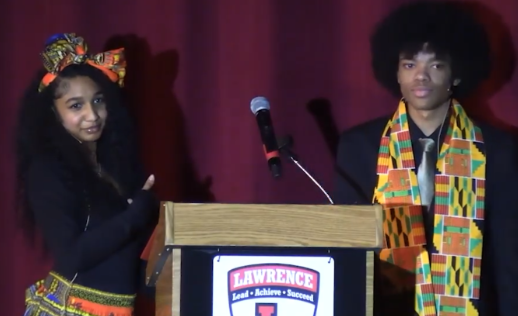
Black history is a fundamental aspect for our country and history. However, Black history is not only a time to recognize the past, but to celebrate culture, build connections, share food, and highlight individual and group efforts that impact our community. The annual Lawrence High School Black History Month Celebration, hosted by LHS’s Black Student Union (BSU), is an event that highlights all of these facets of history. This celebration not only recognizes Black history, but shares a variety of performances, videos, speeches, food, awards, and much more. A big thank you goes out to LHS administration, staff, and BSU club members, and the Student Planning Committee for making this event possible!

The night begins with vending in the cafeteria. Many vendors from Black-owned businesses set up their tables to display their products; many of them displaying their hard work and culture through their products. Along with vending, a diverse selection of food was available for everyone to try. The food came from many different places and cultures, such as African, Caribbean, and soul dishes.
Throughout the celebration, we recognize those who paved the way to be where we are right now. However, a select number of people who impacted our community for the better are chosen to receive the Trailblazer Award. The first honoree was Jeannine Larue! Her journey began as an English teacher in New Jersey, which jumpstarted her career in educational and community service. Over her life, she has served many leadership roles, such as in healthcare, government, public affairs, and higher education. As the first woman, first minority, and youngest person elected in Windsor Township Board of Education and Town Council, LHS congratulates her on receiving this award!
The next honorees are Reverend Dr. Charles F. Boyer and Mrs. Rosalie Boyer, who dedicated their lives to faith in advocacy, racial equity, and systemic transformation through Leadership of Salvation and Social Justice. Salvation and Social Justice is a Black-faith centered organization that commits to public policy reform, criminal justice advocacy, voting rights restoration, and community empowerment.
The last honoree of the night was not just one person, but an organization, named the New Jersey Black Women’s Collective. This organization is not just a regular organization, but a way to empower, uplift, and advocate for Black women through civic engagement initiations, policy advocacy, wellness programming, and much more. The New Jersey Black Women’s Collective reminds us that progress isn’t just an individual act, but rather it is a collective power in motion. Congratulations to our Trailblazer honorees!
Later on, Reverend Dr. Charles F. Boyer gave an inspiring keynote speech. Reverend Boyer serves as senior pastor of a church in Trenton, executive director of Salvation and Social Justice, and is part of a public policy and advocacy organization, which is committed to racial equity and systemic transformation. In his speech, he first recognizes the students who contributed to the program, the honorees, and also all of those who made the event possible. One of the highlights of his speech was observing the themes of the celebration. He recognizes “the power of us, building tomorrow from yesterday’s strength. The theme is not decoration. It’s instruction. Because in moments like this, us is not a slogan. Us is survival.” He acknowledges those in the past; those who are known, and those who were erased from history. “We are living off the seeds that they planted” he declares, and he asks: “Will we plant any of our own?” Boyer goes into great detail and emotion into his speech and informs us all about the importance of Black history. He reminds us that “slavery is not Black history. That’s American history. Slavery is the history of Western civilization.” He exclaims, “[it is] our history [...] of how we survived it.” He preaches about how Black History is how food scraps were turned into cuisine, misery into music, and fear into faith. We were honored to hear Reverend Dr. Charles F. Boyer speak that night, and thank him for reminding us about true Black history.
In between awards and speeches, many musical performances demonstrate the presence of Black history in our community. The first performance was from the Renaissance Jazz Band, who provided amazing entrance and transition music. Their music was phenomenal, as it got the crowd excited for the celebration. Next was the Lawrence Madrigal Choir. Under the leadership of Ms. Mandy St. Pierre Johnson, Madrigal was able to perform two songs named “Hlohonolofatsa” and “Kalinda.” Both of these performances were demonstrations of Black culture originating from Haitian and South African cultures. Another performance was from the award winning LHS Gospel Choir. Thanks to advisors Dr. Jametta Clarke and Mrs. Michelle Page, and the conductor Mr. Parker, they were able to sing repertoire with great emotions and conviction. Songs such as “Lift Every Voice and Sing,” known for being the Black national anthem, and “Ride on King Jesus” were meant to convey Black struggle, culture, and music. Next is the LIS Advanced Choir, also known as “Pitch Black!” Under the direction of Ms. Ploner, their piece “We Shall Not Be Moved” is a spiritual tradition of strength, unity, and unwavering hope against injustice during the Civil Rights Movement. Following that, the LHS Jazz Band did an awesome job with their performance of “Crunchy Frog.” Because of Mr. Mike Drobish, the one responsible for the jazz band, and the band’s members, their precision, commitment, and soloists were made possible. The last performance of the night was from the award-winning Tiffany & Co. Academy of Dance, named “Young People’s Cry.” The art of dance is a way to express our feelings when words fail. This performance reflects voices, emotions, and lived experiences of young people navigating a complex world. It honors resilience, hope, and strength of Black experience in America.

All in all, a huge thank you goes out to all performers, speakers, honorees, hosts, vendors, volunteers, and event coordinators! Without them, this event would not be where it is today. From all these people, we learn their experiences, struggles, culture, and how important it is to recognize those who contribute impactfully to our society. The celebration of Black history shouldn’t last a day or a month, but it should be celebrated every day.
“Black history to me means never giving up and continuously fighting for not only the Black diaspora, but other minority groups so that we can come together as one. The importance of Black history is making sure that we don’t repeat the same mistakes of the past and that we recognize those who have fought and given their lives to make sure that we can have unity and a voice!”
- Aizenomo “Azzy” Akhimien (‘27)
Check out LTSPRewind! “LHS Black History Celebration 2026.”


Comments